Showing posts with label New York City. Show all posts

Saturday, March 26, 2022

The Metro to Reopen on Broadway

 West Side Rag, March 20, 2022:
"Metro Theatre will be a 'community entertainment center' with multiple restaurant-theatres and much more."

Newspaper articles refer to it as an art deco cinema but the interior was demolished in 2006 to prepare the space for retail use.

David Dunlap, New York Times, November 14, 2007:
"the inside, visible to passers-by on a recent afternoon, has been gutted. Gone are seats and plaster and curtains and screen. Gone is a golden ceiling molding with a chain of floral bouquets. Gone are the sylph-filled niches. Gone is grille work that sprouted like corn stalks."


The Metro, 2626 Broadway, opened in 1933 as the Midtown, part of Ochs circuit of theatres. 

The New York State Exhibitor, June 10, 1933:
"Midtown theatre, new Lee Ochs house, opened the past weekend. Sam Chernow managing. House seats 600."

The New York State Exhibitor, June 25, 1933:
"the Ochs circuit signalized the opening of its new Midtown theatre by covering the vicinity of the new house with a twelve-color display done in ADC's multi-color process."


Motion Picture Herald, October, 21, 1933:


"The façade- its terra cotta and aluminum pattern by day and its illuminate effect with floods and  tubes at night."


"The auditorium as seen from the stadium."
"The Midtown is of the stadium type, with the 590 seats distributed equally between the stadium section and forward area, each of which contains 14 rows."  


Motion Picture Herald, September 22, 1934:
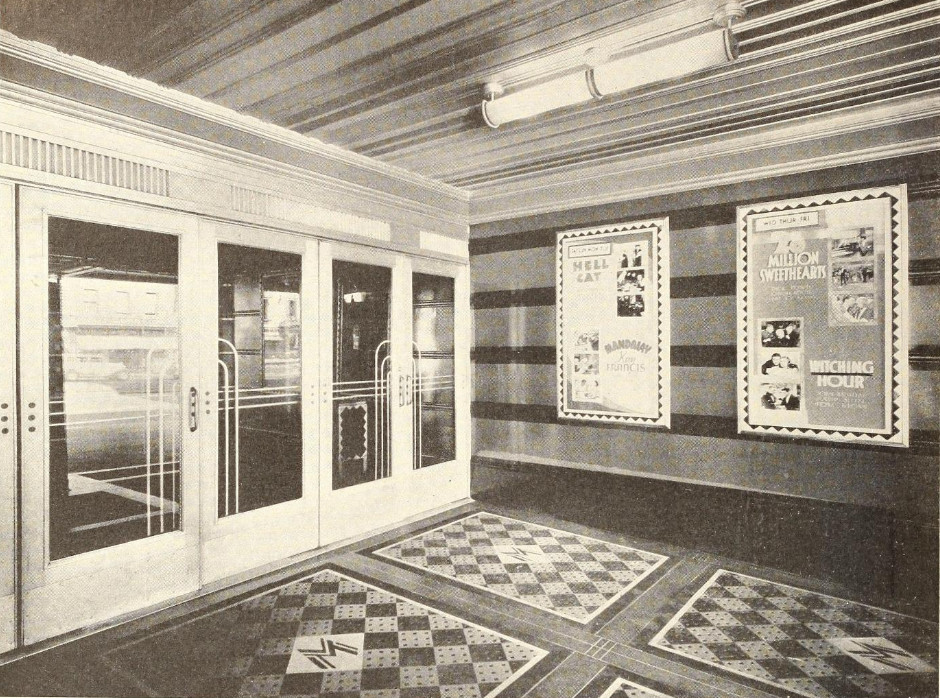

Midtown "is one of the newest theatres which afford suggestions for the modernization of older theatres.

"In the lobby, the walls are covered with Formica sheets in horizontal bands of rich red inlaid with 2 inch strips of black at the edges." 


New York Post 

The Real Deal

Cinema Treasures


Since 1997 theatre historian,  Cezar Del Valle, has conducted a popular series of  theatre talks and walks, available for  historical societies, libraries, senior centers, etc.
Del Valle is the author of the Brooklyn Theatre Index, a three-volume history of borough theatres.
The first two chosen 2010 OUTSTANDING BOOK OF THE YEAR by the Theatre Historical Society. Final volume published in September 2014.
Currently seeking funding for “Editing & Formatting” the first three volumes of the Brooklyn Theatre Index, 3rd Edition


Friday, January 28, 2022

Tallest on Broadway

 Motion Picture Herald, November 10, 1951:


"Really, the tallest and most spectacular figure ever built on Broadway. The principal character in this great display for 'Ten Tall Men' at the Victoria theatre, is sixty-five feet high, and surrounded with colorful--and expensive--art work." 


Since 1997 theatre historian,  Cezar Del Valle, has conducted a popular series of  theatre talks and walks, available for  historical societies, libraries, senior centers, etc.
Del Valle is the author of the Brooklyn Theatre Index, a three-volume history of borough theatres.
The first two chosen 2010 OUTSTANDING BOOK OF THE YEAR by the Theatre Historical Society. Final volume published in September 2014.
Currently seeking funding for “Editing & Formatting” the first three volumes of the Brooklyn Theatre Index, 3rd Edition


Friday, September 24, 2021

Prospect Hall and the Venetian Gardens


Brooklyn's historic Prospect Hall is slated for demolition. In 1908, the hall and its outdoor gardens  were also the studios of the Crescent Film Company operated by Herman Kolle (brother of hall proprietor William Kolle) and Fred J. Balshofer.


Excerpts from One Reel a Week by Fred J. Balshofer and Arthur C. Miller, University of California Press 1967:

“Next to and in connection with the dance hall was an open air summer beer garden. On warm summer evenings neighborhood families would sit around at the separate tables, drink nickel schooners of beer, and watch second-rate vaudeville on a stage raised about seven feet above the ground. A screen rolled down from the arch over the stage and this was used to show movies.

“A song plugger sang popular tunes, accompanied by a piano, while the hand-colored lantern slides on the screen changed according to the lyrics of the song. There was only enough business to warrant operating on Saturday and Sunday evenings. If it rained, people would move into the dance hall and the show would continue there.” 

“We used one corner of the summer garden for our open-air studio and, as in the early days of Lubin, daylight was our only source of light for photography. We arranged a tiny laboratory under the stage and bought a used Pathe field camera that had seen better days.”


The Moving Picture World, November 28, 1908


Since 1997 theatre historian,  Cezar Del Valle, has conducted a popular series of  theatre talks and walks, available for  historical societies, libraries, senior centers, etc.
Del Valle is the author of the Brooklyn Theatre Index, a three-volume history of borough theatres.
The first two chosen 2010 OUTSTANDING BOOK OF THE YEAR by the Theatre Historical Society. Final volume published in September 2014.
Currently seeking funding for “Editing & Formatting” the first three volumes of the Brooklyn Theatre Index, 3rd Edition

Friday, September 10, 2021

Loew's Paradise Theatre, 2413 Grand Concourse, Bronx, NY


The Paradise was one of the five "Wonder Theatres" built by Loew’s Inc. and named for the Robert Morton ‘Wonder Organ’ installed in each. Four were constructed in New York City and one in Jersey City.

On January 7 1929, the Loew's Valencia, Jamaica, Queens,  would be the first of the Wonder Theatres to open its doors.  The Loew’s Paradise was a joint-second, opening the same day, September 7, 1929 as the Loew’s Kings in Brooklyn.


Loew's Paradise Theater - 1930  (The George Mann Archive)


Motion Picture News, March 1930:

"In this [Italian Baroque] design John Eberson, the architect, has conceived a formal style, drawing away from the over-elaborateness of the French style of Louis XV period.


 "One end and sidewall of foyer where minute detail continues in the design. The massiveness conveyed by stout  pillars supporting the ceiling, combined with the splendor of pendent lighting fixtures, together with openings into the mezzanine floors, lends something akin to the colossal reaches of Rome's ancient forums." 


"The main staircase shows detail work that is found throughout the interior. Here it has been concentrated on sidewall and ceiling with the general effect, straight ahead, of being entirely surrounded by palatial elegance."


"Above a sweeping panorama of auditorium taken from right side of house showing the splendor of the Italian Baroque design, with the infinite detail from floor to ceiling and extending to the proscenium arch. Note the clouded sky effect as though patrons were seated in a huge out-door amphitheater  under the sky."


Tour the Loew's Paradise


Since 1997 theatre historian,  Cezar Del Valle, has conducted a popular series of  theatre talks and walks, available for  historical societies, libraries, senior centers, etc.
Del Valle is the author of the Brooklyn Theatre Index, a three-volume history of borough theatres.
The first two chosen 2010 OUTSTANDING BOOK OF THE YEAR by the Theatre Historical Society. Final volume published in September 2014.
Currently seeking funding for “Editing & Formatting” the first three volumes of the Brooklyn Theatre Index, 3rd Edition


Friday, August 6, 2021

Theatre Television Demonstrated, 1941

 Motion Picture Herald, February 1, 1941:

"Theatre television as demonstrated by RCA  in the New Yorker theatre, New York."


"The top photograph shows the large screen projection equipment installed in the balcony of the theatre
 60 feet from the 15 by 20-foot screen."


"The arrangement of controls, projector and loud-speakers for multisonic sound are shown in the artist conception above."


"Map of the relay system constructed to send pictures from the RCA mobile unit at Camp Upton 
to the theatre for the demonstration." 


Since 1997 theatre historian,  Cezar Del Valle, has conducted a popular series of  theatre talks and walks, available for  historical societies, libraries, senior centers, etc.
Del Valle is the author of the Brooklyn Theatre Index, a three-volume history of borough theatres.
The first two chosen 2010 OUTSTANDING BOOK OF THE YEAR by the Theatre Historical Society. Final volume published in September 2014.
Currently seeking funding for “Editing & Formatting” the first three volumes of the Brooklyn Theatre Index, 3rd Edition


Thursday, July 8, 2021

"An Experiment in Film Design"

Exhibitors Herald-World, March 16, 1929

Excerpts from an article by Douglas Fox


"Important among the features of the Film Art Guild's new theatre in New York is the 'screenoscope,' designed by Frederick Kiesler of Vienna. In 1918 Kiesler began his plans for an 'ideal motion picture theatre.' It was Kiesler who designed the Film Art Cinema."

"This theatre, which was opened February 1, seats only 485 persons. Yet it incorporates much that is new in both vision and acoustics and combines the greatest projection economy with the utmost in projection scope." 


"A section of the lounge, a chamber of modern comfort
and modernistic appointments--in both respects candid to the point of bluntness." 


"The auditorium looking towards the rear, showing the arrangement of the indirect lighting
and deeply upholstered, chair-like, blue and silver seating." 


  "The left side of the auditorium, showing the black wall strip used as a second screen.
The ceiling flares upwards towards the rear." 


"The 'camera eye,' half shut.
This feature, called by the inventor the 'screenoscope,' is well shown
in this photograph of the auditorium."  


House of Shadow Silence,
an audio/visual virtual reality experience that transports audiences to a simulation of the historic Film Guild Cinema. 


Film Guild Cinema
52 W. 8th Street,
New York,
NY

Renamed 8th Street Playhouse on May 14, 1930.
Closed
November 26, 1992.


Since 1997 theatre historian,  Cezar Del Valle, has conducted a popular series of  theatre talks and walks, available for  historical societies, libraries, senior centers, etc.
Del Valle is the author of the Brooklyn Theatre Index, a three-volume history of borough theatres.
The first two chosen 2010 OUTSTANDING BOOK OF THE YEAR by the Theatre Historical Society. Final volume published in September 2014.
Currently seeking funding for “Editing & Formatting” the first three volumes of the Brooklyn Theatre Index, 3rd Edition


Friday, April 2, 2021

Easter on Broadway in July

 Boxoffice, July 31, 1948:


"Coincident with the interior renovations at the State Theatre, New York, the house
displayed the new exterior look in honor of current screen offering, 'Easter Parade.' 

Even local citizens, accustomed to spectacular Broadway signs,  got a kick
looking up at 40-foot cutout figures which adorned building facade."  


Easter Parade


Since 1997 theatre historian,  Cezar Del Valle, has conducted a popular series of  theatre talks and walks, available for  historical societies, libraries, senior centers, etc.
Del Valle is the author of the Brooklyn Theatre Index, a three-volume history of borough theatres.
The first two chosen 2010 OUTSTANDING BOOK OF THE YEAR by the Theatre Historical Society. Final volume published in September 2014.
Currently seeking funding for “Editing & Formatting” the first three volumes of the Brooklyn Theatre Index, 3rd Edition


Tuesday, February 16, 2021

Tarzan Swings Into Broadway

 Excerpts from Motion Picture News, February 2, 1918:

"William Parsons, President of National Film Corporation of America, leases Broadway [Theatre] for extended run of 'Tarzan of the Apes.'" 

"Mr. Parsons announces that the lobby of the Broadway theatre will be transformed into a miniature jungle as an appropriate display for his production."  


  Excerpts from Motion Picture News, February 16, 1918:


"Harry Reichenbach's banner across Broadway speaks for its self, and William Parson's feature production is doing likewise."

"The opening of 'Tarzan of the Apes,' the National Film Company of America's special production, at the Broadway theatre, January 27, was one of the biggest and most successful openings ever attributed to a picture on Broadway. With about 50 per cent of the house given to the trade, it is estimated that thousands were turned away on opening night." 


Tarzan of the Apes


Elmo Lincoln 


Since 1997 theatre historian,  Cezar Del Valle, has conducted a popular series of  theatre talks and walks, available for  historical societies, libraries, senior centers, etc.
Del Valle is the author of the Brooklyn Theatre Index, a three-volume history of borough theatres.
The first two chosen 2010 OUTSTANDING BOOK OF THE YEAR by the Theatre Historical Society. Final volume published in September 2014.
Currently seeking funding for “Editing & Formatting” the first three volumes of the Brooklyn Theatre Index, 3rd Edition


Friday, August 9, 2019

Adieu Bijou


Cinema and underground cruising spot has closed.


Bijou, 82 East 4th Street, New York

"Shows old movies to gay patrons who aren't watching them"
--New York Songlines

From the very beginning this subterranean space has served as an entertainment venue.

Certificate of Occupancy, October 22, 1927:
Cellar-- Persons Accommodated 150-- Restaurant, cabaret, and storage    

Originally the Rainbow Inn, it became Club 82 in 1954 (some accounts list 1958), famous for spectacular drag reviews.
Business partner Vito Genovese. like many mobsters, "financed Village gay bars, which were prevented from obtaining legitimate funding due to homophobic laws and social stigmas."


Various sources credit the New York Dolls, in 1973 or 74,  as the first rock group to play there.

"I was manager of the Dolls and I was approached by the club because they were switching over to glam rock bands. The drag crowd had moved on and the Club 82 never returned to the original format." 

A comment on the blog "It's All Streets You Crossed" differs:
"So many [sic] of the information regarding Club 82, in the glam period, are [sic] incorrect. Club 82 started having bands in '72, not '74. The Dolls were not the first band to play there. Another Pretty Face was the already house band there in '73." 

 An indie-film theatre took over the space in 1978, followed by an all-male strip club. Ron Wood opened the music venue Woody's in 1990, a dismal failure closing after only a few months.

Since  about 1992, the basement has been an on-again-off-again unmarked gay porn theater called the Bijou, featuring second-run Hollywood films in the main theatre with a separate row of private booths.

The Bijou closed for the final time in April 2019, the space has been gutted. According to the New York City Department of Buildings a "stop work order exists on this building."


Since 1997 theatre historian,  Cezar Del Valle, has conducted a popular series of  theatre talks and walks, available for  historical societies, libraries, senior centers, etc.
Del Valle is the author of the Brooklyn Theatre Index, a three-volume history of borough theatres.
The first two chosen 2010 OUTSTANDING BOOK OF THE YEAR by the Theatre Historical Society. Final volume published in September 2014.
Currently seeking funding for “Editing & Formatting” the first three volumes of the Brooklyn Theatre Index, 3rd Edition