Showing posts with label Movie House. Show all posts

Monday, July 18, 2022

Stars Light up the Marquee at the Rialto

Rialto Theatre
5345-6347 Gratiot Avenue
Detroit, MI


The Exhibitor, January 21, 1942

"Renovations to the front of this house brought forth a new marquee on which are being used color transparencies of stars and plastic letters in opaque black and red in varied sizes which allow better composition."

Rialto Theatre

When Ladies Meet

Charlie Chan in Rio


Since 1997 theatre historian,  Cezar Del Valle, has conducted a popular series of  theatre talks and walks, available for  historical societies, libraries, senior centers, etc.
Del Valle is the author of the Brooklyn Theatre Index, a three-volume history of borough theatres.
The first two chosen 2010 OUTSTANDING BOOK OF THE YEAR by the Theatre Historical Society. Final volume published in September 2014.
Currently seeking funding for “Editing & Formatting” the first three volumes of the Brooklyn Theatre Index, 3rd Edition


Friday, June 24, 2022

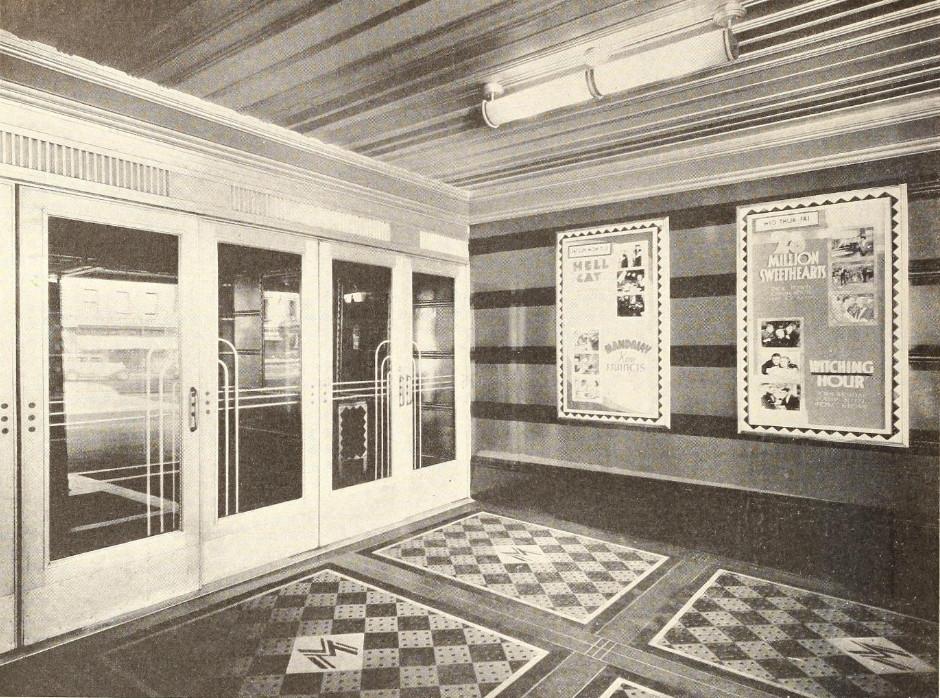
The New Centre Theatre and Station WFBR

 The Exhibitor, September 20, 1939:
 
 "That Baltimore might have its branches of the world's two most popular forms of entertainment, radio and motion pictures, combined under one roof, and in a setting conducive to both, Morris A. Mechanic, Baltimore exhibitor, retained Armand Carroll, Philadelphia architect to design a suitable structure."  
 

 "The front with its majestic upright sign is indeed a credit to its designer. Travertine and black Virginia stone were used here with striking results. The upright sign and marquee are of porcelain enamel constructed with stainless steel trim."  
 
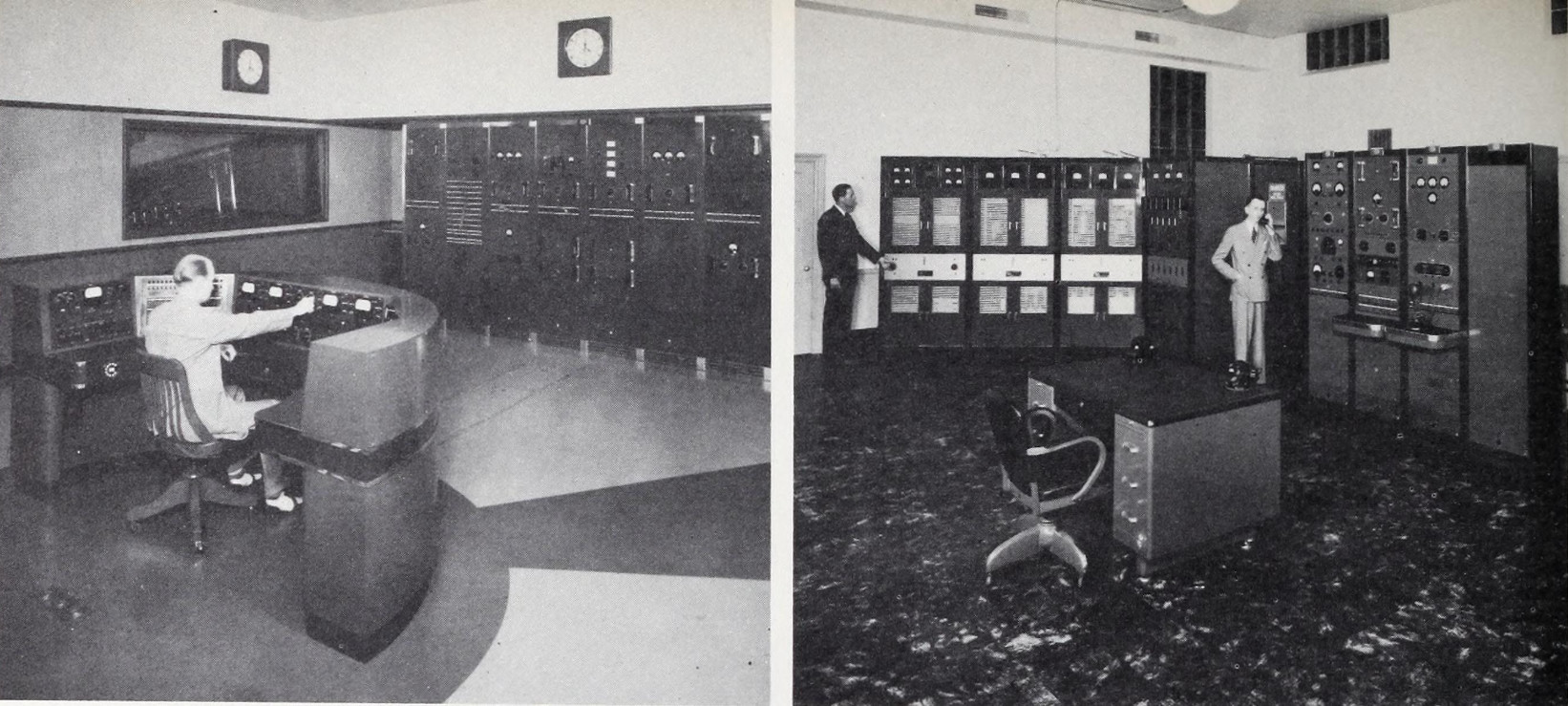
 Station WFBR
 

 "Radio station WFBR, which occupies the second floor of the theatre building, is said to be the most  modern station in the country. Its six studios include exceptional facilities for accommodating large audiences for local shows." 
 
Centre Theatre
 

 "The Facade as it appears from a more central point. From this view is gained a better perspective of the overall design. The black stone portion which extends out from the face of the building allows a space directly in front of the radio station windows for potted shrubbery." 
 

 "The inside lobby which leads into the standee room is without furnishings. Its most prominent feature is the large mural done on green linoleum. This mural is indirectly lighted from a trough immediately behind."   
 

"The standee room is well carpeted in a standard Crestwood pattern of black and gold. The standee railing has been covered with padded natural pigskin leather ornamented with bronze stars, and molding.  Aisles are of luminous glass and are back lighted ."  
 
"The proscenium design is a definite departure from the usual formula. A perfect circle, it is broken only by the  upper  side walls of asbestos transite, which flows gracefully into it. The lower portion of the walls have been covered with green and gold damask and have grained walnut plywood as a wainscot. The curved ceiling, with a number of small direct lighting fixtures supplemented by coves for indirect illumination, is of hard white plaster and painted in a shade of ecru." 


Since 1997 theatre historian,  Cezar Del Valle, has conducted a popular series of  theatre talks and walks, available for  historical societies, libraries, senior centers, etc.
Del Valle is the author of the Brooklyn Theatre Index, a three-volume history of borough theatres.
The first two chosen 2010 OUTSTANDING BOOK OF THE YEAR by the Theatre Historical Society. Final volume published in September 2014.
Currently seeking funding for “Editing & Formatting” the first three volumes of the Brooklyn Theatre Index, 3rd Edition


Wednesday, May 25, 2022

The New Telenews, Chicago

 The Exhibitor, April 17, 1940

"In recent years the motion picture industry has seen the advent of newsreel theatres. These houses screen the industry's weekly newsreel output as the feature attraction and fill in with sufficient short subjects of merit to make up a definite program."

"Pictured here is just such a house designed by Shaw, Naess and Murphy for the Newsreel Theatres, Inc., Chicago." 


"The exterior of this newsreel house is of a design typical of that current for this type of theatre. A huge triangular marquee extends well out and across the sidewalk, gaining much attention over the neighboring stores. Prominent in this view is the stainless steel boxoffice with its automatic turnstile." 


"The auditorium is small as is usual with most newsreel houses. A balcony with a capacity of approximately 150  capably handles  the first floor overflow. Simple in its decoration the sidewalls of this room are of blue green painted plaster. The rear wall is acoustically treated and in the natural color of the material. The lighting fixtures are brass and were designed especially for this house."


"The exterior at night fully illuminated shows the attractiveness of the signwork
and the extent of the exploitation necessary for this type of theatre."


Telenews

165 N. State Street 

Cinema Treasures 


Since 1997 theatre historian,  Cezar Del Valle, has conducted a popular series of  theatre talks and walks, available for  historical societies, libraries, senior centers, etc.
Del Valle is the author of the Brooklyn Theatre Index, a three-volume history of borough theatres.
The first two chosen 2010 OUTSTANDING BOOK OF THE YEAR by the Theatre Historical Society. Final volume published in September 2014.
Currently seeking funding for “Editing & Formatting” the first three volumes of the Brooklyn Theatre Index, 3rd Edition


Saturday, March 26, 2022

The Metro to Reopen on Broadway

 West Side Rag, March 20, 2022:
"Metro Theatre will be a 'community entertainment center' with multiple restaurant-theatres and much more."

Newspaper articles refer to it as an art deco cinema but the interior was demolished in 2006 to prepare the space for retail use.

David Dunlap, New York Times, November 14, 2007:
"the inside, visible to passers-by on a recent afternoon, has been gutted. Gone are seats and plaster and curtains and screen. Gone is a golden ceiling molding with a chain of floral bouquets. Gone are the sylph-filled niches. Gone is grille work that sprouted like corn stalks."


The Metro, 2626 Broadway, opened in 1933 as the Midtown, part of Ochs circuit of theatres. 

The New York State Exhibitor, June 10, 1933:
"Midtown theatre, new Lee Ochs house, opened the past weekend. Sam Chernow managing. House seats 600."

The New York State Exhibitor, June 25, 1933:
"the Ochs circuit signalized the opening of its new Midtown theatre by covering the vicinity of the new house with a twelve-color display done in ADC's multi-color process."


Motion Picture Herald, October, 21, 1933:


"The façade- its terra cotta and aluminum pattern by day and its illuminate effect with floods and  tubes at night."


"The auditorium as seen from the stadium."
"The Midtown is of the stadium type, with the 590 seats distributed equally between the stadium section and forward area, each of which contains 14 rows."  


Motion Picture Herald, September 22, 1934:


Midtown "is one of the newest theatres which afford suggestions for the modernization of older theatres.

"In the lobby, the walls are covered with Formica sheets in horizontal bands of rich red inlaid with 2 inch strips of black at the edges." 


New York Post 

The Real Deal

Cinema Treasures


Since 1997 theatre historian,  Cezar Del Valle, has conducted a popular series of  theatre talks and walks, available for  historical societies, libraries, senior centers, etc.
Del Valle is the author of the Brooklyn Theatre Index, a three-volume history of borough theatres.
The first two chosen 2010 OUTSTANDING BOOK OF THE YEAR by the Theatre Historical Society. Final volume published in September 2014.
Currently seeking funding for “Editing & Formatting” the first three volumes of the Brooklyn Theatre Index, 3rd Edition


Monday, February 21, 2022

Decorating with Lights

Motion Picture Herald, September 17, 1938: 

"Decorating with light achieves some spectacular expression in the new Cine Presidente Roca in Buenos Aires, Argentina's capital." 


"The auditorium ceiling gives the effect of being suspended, owing to the coves which separate it from the walls, creating a cornice of light."

"Running down the center of ceiling, coves on either side of reflecting bands throw them in relief."   

"The auditorium is further distinguished by having 950 of its 1,800 seats in the balcony."


"The soffit of  balcony opens up into a great flower petal bathed with light from coves at the escalloped modeled rim." 


"The proscenium arch is ringed with lights from sources concealed behind moulding borders"

"The Cine Presidente  Roca is owned and operated by Clemente Lococo, who heads one of the largest circuits operating in the Argentine Republic. The architect was Alberto Bourdon." 


Since 1997 theatre historian,  Cezar Del Valle, has conducted a popular series of  theatre talks and walks, available for  historical societies, libraries, senior centers, etc.
Del Valle is the author of the Brooklyn Theatre Index, a three-volume history of borough theatres.
The first two chosen 2010 OUTSTANDING BOOK OF THE YEAR by the Theatre Historical Society. Final volume published in September 2014.
Currently seeking funding for “Editing & Formatting” the first three volumes of the Brooklyn Theatre Index, 3rd Edition


Thursday, August 26, 2021

This is a Theatre!

 Motion Picture Herald, December 9, 1939:

Tumbleweed Theatre

...yes, and a fetching one to the city-farmers of Five Points [California], who gather here for mental and emotional subsistence-plus. 


He Operates It


James Edwards, Jr.

The theatre operator's problem was to build a low-cost theatre, as the size of the community would not justify a large expenditure.  


He Designed It

S. Charles Lee

Analysis of the budget and the and the area to be covered by the building left the architect--S. Charles Lee of Los Angeles--with funds to build a shell which appeared to be nothing more than a barn. A barn? 

The idea crystallized. Why not build a barn project that would be 'artistic,' and clever, and would afford more entertainment by reason of its novelty than a cheap 'modernistic' or similar type of building, where the price would reflects itself in weak substitution of materials? Thus came the idea of the Tumbleweed Theatre.


And here is the town for which it was built (theatre in right foreground).


The wishing well in the 'barnyard.'


The foyer-lounge, done in the farmhouse style.


General view of the auditorium. 


Since 1997 theatre historian,  Cezar Del Valle, has conducted a popular series of  theatre talks and walks, available for  historical societies, libraries, senior centers, etc.
Del Valle is the author of the Brooklyn Theatre Index, a three-volume history of borough theatres.
The first two chosen 2010 OUTSTANDING BOOK OF THE YEAR by the Theatre Historical Society. Final volume published in September 2014.
Currently seeking funding for “Editing & Formatting” the first three volumes of the Brooklyn Theatre Index, 3rd Edition


Thursday, July 8, 2021

"An Experiment in Film Design"

Exhibitors Herald-World, March 16, 1929

Excerpts from an article by Douglas Fox


"Important among the features of the Film Art Guild's new theatre in New York is the 'screenoscope,' designed by Frederick Kiesler of Vienna. In 1918 Kiesler began his plans for an 'ideal motion picture theatre.' It was Kiesler who designed the Film Art Cinema."

"This theatre, which was opened February 1, seats only 485 persons. Yet it incorporates much that is new in both vision and acoustics and combines the greatest projection economy with the utmost in projection scope." 


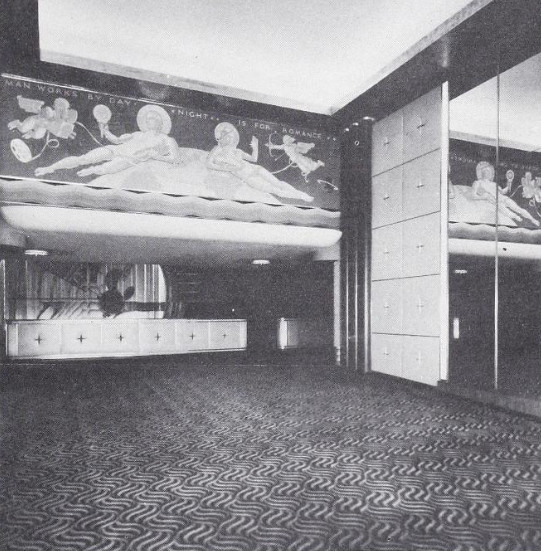
"A section of the lounge, a chamber of modern comfort
and modernistic appointments--in both respects candid to the point of bluntness." 


"The auditorium looking towards the rear, showing the arrangement of the indirect lighting
and deeply upholstered, chair-like, blue and silver seating." 


  "The left side of the auditorium, showing the black wall strip used as a second screen.
The ceiling flares upwards towards the rear." 


"The 'camera eye,' half shut.
This feature, called by the inventor the 'screenoscope,' is well shown
in this photograph of the auditorium."  


House of Shadow Silence,
an audio/visual virtual reality experience that transports audiences to a simulation of the historic Film Guild Cinema. 


Film Guild Cinema
52 W. 8th Street,
New York,
NY

Renamed 8th Street Playhouse on May 14, 1930.
Closed
November 26, 1992.


Since 1997 theatre historian,  Cezar Del Valle, has conducted a popular series of  theatre talks and walks, available for  historical societies, libraries, senior centers, etc.
Del Valle is the author of the Brooklyn Theatre Index, a three-volume history of borough theatres.
The first two chosen 2010 OUTSTANDING BOOK OF THE YEAR by the Theatre Historical Society. Final volume published in September 2014.
Currently seeking funding for “Editing & Formatting” the first three volumes of the Brooklyn Theatre Index, 3rd Edition


Tuesday, June 22, 2021

Pre-historic Ballyhoo in Louisville


Photographic Archives, Ekstrom Library, University of Louisville


Showmen's  Trade Review, April 13, 1940:
"Louisville, Ky.--A special pre-release premiere of Hal Roach's 'One Million B. C.' was held here last week, with Victor Mature, star of the picture, making a personal appearance." 


Showmen's Trade Review, June 8, 1940:


"When the recent world premiere of Hal Roach's United Artists release, 'One Million B. C.,' took place at Loew's Theatre, Louisville, Ky., one of the highlights of the campaign was this ballyhoo truck which traversed the entire city. 

The specially constructed pre-historic animal attracted plenty of attention, as did also the young man and woman attired in costumes similar to those worn by characters in the picture."
 

 One Million B. C.


Since 1997 theatre historian,  Cezar Del Valle, has conducted a popular series of  theatre talks and walks, available for  historical societies, libraries, senior centers, etc.
Del Valle is the author of the Brooklyn Theatre Index, a three-volume history of borough theatres.
The first two chosen 2010 OUTSTANDING BOOK OF THE YEAR by the Theatre Historical Society. Final volume published in September 2014.
Currently seeking funding for “Editing & Formatting” the first three volumes of the Brooklyn Theatre Index, 3rd Edition